超塑性技術の概略
The research on the superplasticity of the microcrystalline material structure (the average size of the grains usually does not exceed 10 ~ 20μm) is at elevated temperatures and relatively low deformation speed (usually 10-4 ~ 10-3s-1) ongoing. In fact, it has been determined that any polycrystalline material, including industrial alloys such as aluminum-based, titanium-based, and nickel-based, can be transformed into a superplastic state. In many cases, the use of superplasticity in metal pressure processing can ensure lower deformation forces, reduce the number of process steps, and improve the mechanical properties and dimensional accuracy of semi-finished products. Under conventional forging conditions, the forging temperature range of these metal materials is relatively narrow, especially when rolling thin plates, high ribs, and thin-walled parts, the heat of the billet is quickly absorbed by the tool, and the temperature drops rapidly. Not only does it need to greatly increase the tonnage of the equipment, but it is also easy to cause cracking of the tooling. Especially titanium alloy is more obvious, it is very sensitive to deformation temperature, when the deformation temperature drops from 920 ℃ 820まで ℃、変形抵抗はほぼ 2 倍になります。チタン合金の超塑性変形力は通常の圧延加工の1/30~1/10程度です。 チタン合金は、航空宇宙、自動車、生物医学などの多くの産業分野で広く使用されています。ご存知のとおり、多くのチタン合金は供給状態では塑性が低く、組織が不均一です。したがって、これらの材料から安価で高品質の複雑な部品を得ることが緊急の実用上重要です。この問題を解決する効果的な方法の 1 つは、超塑性技術を使用することです。残念ながら、さまざまな合金で超微細粒子を製造するのは難しく、高価です。
粗粒超塑性
OIВyly а、Р.L.Вlekvell (英国グラスゴーストラスクライド大学ストラスクライド)、Р.А.Васин (ロシア、マリ国立大学機械工学部)、MKSаrаndzhi (インド技術教育研究大学院) が協力粗粒超塑性の研究について。 超塑性プレス成形の主な利点の 1 つは、材料が非常に大きな変形を達成できることです。ただし、多くのプロセスでは 100% ~ 200% の変形は必要ありません。一般に金属の鍛造比は5、つまり変形率は75%に達します。部品の高い保守性を確保するために、常に最適化が必要なわけではありません。さらに、粗い層状微細構造は、疲労亀裂の伝播に対してより優れた安定性を備えています。 In order to obtain high-quality blanks, rough-grained material blanks are first used, whose microstructure cannot guarantee the typical superplastic grain boundary slip deformation mechanism. Under this condition, since the sensitivity to deformation rate is lower than the material superplastic condition, the material can be deformed and softened, and the microstructure can be transformed during deformation. Experimental studies have pointed out that this process can be called approximate superplastic deformation, and some parts of the grain are broken, which can reach a relatively high deformation of 100% to 300%. Coarse-grained titanium alloys are used in the hot die forging of automobile wheel hubs. Two-phase (α+β) titanium alloys with flaky (Widmandelsteiner) microstructure have initial broken grains. β-phase about 250 μkm, α-phase flakes The average length is about 21 μkm and the thickness is about 2 μkm. This example simulates the process and analyzes the obtained results, demonstrating the feasibility of approximate superplasticity techniques. 図 14 に示す粗粒超塑性鍛造チタン合金自動車ホイール成形プロセス シミュレーション。簡略化のため、すべてのプロセス シミュレーションでは等温 (T=900) を使用します。℃)、接触面の摩擦係数は同じ 0.5 で、ガラス潤滑剤を使用すると仮定します。 ハイエンド自動車ホイールハブ用の粗粒超塑性成形ステップ。
TC4リム用粗粒ブランクの変形結果
From the standpoint of rim deformation, 3 -step die forging is still feasible (Fig. 16). It is not difficult to see that at the end of the third step, the cumulative plastic deformation of this part is 300% to 400%, in some places it exceeds 450%, and in some points, it even exceeds 500%. Although the deformation results showed that the microstructure uniformly changed to 30 to 35 μkm at the end of the second step and to 20 to 25 μkm at the end of the third step, the tensile elongation of the specimen with such a microstructure unexpectedly reached δ=400 %~500%。主題のシミュレーションは、鍛造品のすべての厳しい変形領域で、鍛造品の平均応力が(静水圧圧縮の条件下で)負であること、つまり、亀裂の原因や気孔が排除され、性能が非常に優れていることを示しています。高い。
低温超塑性
最新の航空機エンジンのファンとコンプレッサーブレードは、一部がカーボンファイバーでできています。構造強度と信頼性を確保した上での軽量化により、チタン合金ブレードとの高い競争力を発揮します。しかし、カーボンファイバーブレードの最大の弱点は、衝撃靱性が低すぎることです。使用過程において、前縁部に砂、砂利、鳥などが衝突し、航空機の墜落や死亡といった重大な事故を引き起こす可能性があります。この厄介な問題を解決するために、ブレードの先端は固定部品や接着剤によって高強度のチタン合金の保護カバーで覆われています。しかし、チタン合金ブーツの製造は、非常に複雑な課題です。なぜなら、ブーツには、薄い壁や強化された重いリーディングエッジ断面など、さまざまな断面があるからです。また、シースは水平方向の湾曲形状や垂直面の曲率など、複雑な空間形状を有している。
American Nonferrous Gas Turbine Corporation (Chromаloy Gаs Turbine Corporation US-) は、シースを製造するためにチタン合金 Ti-6Аl-4V の三次元ブランクを設計および使用しました。ブランクはフライス加工され、内部に V 字型のポケットが作成されます。次に、最終機械加工の前に、側壁がダイ内で押し出されます。押出温度は850~900℃ ℃、保護ガスがなければ表面ガスは飽和します。この部品の肉厚はわずか0.2~0.5mmで、製造には非常に困難な機械加工が必要です。 2018年11月27日、上海で「2018年(第11回)国際自動車技術年次会議および『自動車技術革新賞』授賞式」が盛大に開催された。 2018年(第11回)国際自動車技術年次会議は、新エネルギー車、エネルギー管理、自動運転、インテリジェントネットワーキング、軽量およびその他の業界のホットスポットに焦点を当て、専門的な技術交流を実施し、最先端の技術共有プラットフォームを構築することを目的としています。 「自動車技術イノベーション賞」授賞式は、自動車および部品業界における先進技術の創造者および推進者を表彰することを目的としています。スピーチの専門家、国内外の自動車 OEM および自動車部品サプライヤー、大学研究機関の代表、協会および政府機関の代表、メディア代表が 400 名を超えるゲストと綿密な専門的および技術的な交流を行い、共により良い社会の実現を期待しました。旅行の未来。
曲げは共押出後に行う必要があります (図 18)。
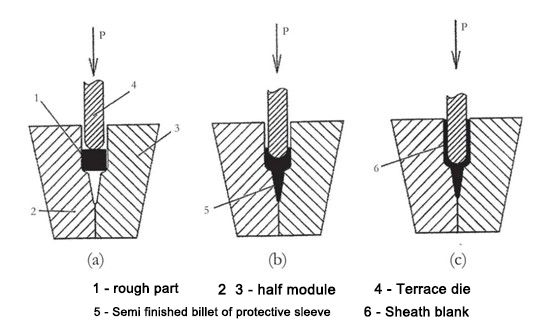
複合押出のさまざまな段階のプロセスステップ 提案された複合押出プロセスの実現可能性を検証するために、デジタル シミュレーション手法が使用されました。シミュレーション プロセスは Deform 3D ソフトウェアを使用して確立され、モデルは次の基本的な仮定を使用して確立されました。
- 元のブランクは 98000 個の有限要素に分割されます。
- 剛体としての型。
——The movement speed of the punch is 0.5mm/min;
——The friction between the blank and the mold is set to Coulomb friction, μ=0.2;
——Metal flow under isothermal conditions, blank temperature = 650 ℃;
- 成形プロセスでは、ブランクの異方性や再結晶さえも考慮されません。
図 18 曲げステップのスケッチ
The initial size of the blank: is 5mm × 10mm × 270mm. It is confirmed that the blank material adopts the titanium alloy Ti-6Аl-4V with rheological characteristics collected from this database.
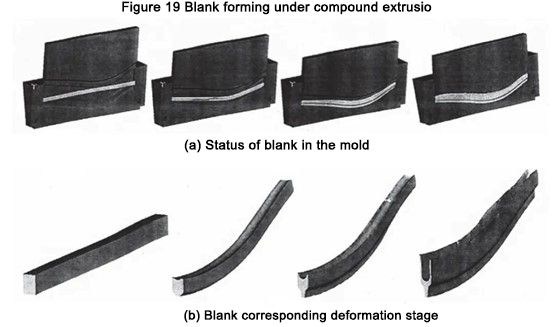
金型内でブランクを変形させたときの状態とその段階の成形イメージを図19に示します。
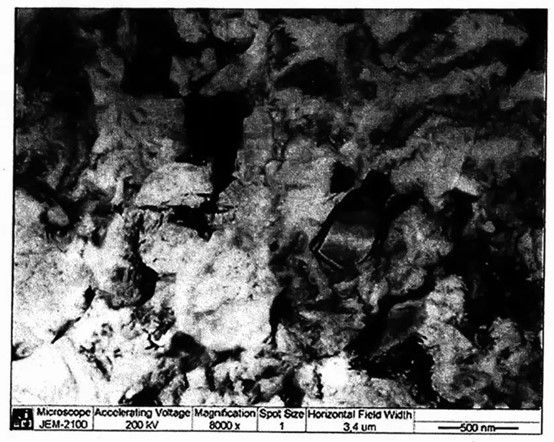
図 19 複合押出によるブランク成形n
The simulation results show that the proposed process is feasible, the wall is formed uniformly, and the logarithmic deformation degree at the wall reaches e ≈ 3. The recommended process is effective at temperatures not exceeding 700°C, which reduces the cost of manufacturing mold parts.
We know that titanium alloys including TC4 (Ti-6Аl-4V) in the ultrafine grain state affect the low-temperature superplasticity effect. The preparation of the ultra-fine grain structure of the blank includes the use of a bar with a diameter of φ70mm, changing the axial load, upsetting several times under the condition of gradually reducing the temperature, and then rolling at 600 °C to a thickness of 5mm. The degree of logarithmic deformation e ≈ 3. Deformation results The average grain size is 0.5 μm (Figure 20).
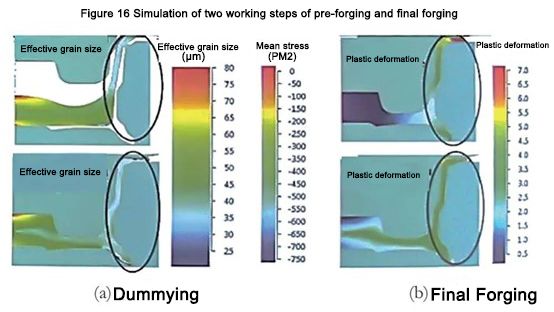
図 20 ブランクの微細構造
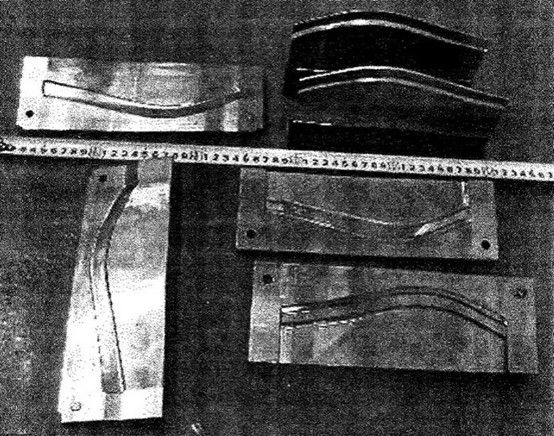
提案されたチタン合金温度は650〜950℃です ℃、圧力処理プロセスでは、次の材料ラベル コーティングが採用されています。FR-6 ガラス潤滑剤をオリジナル ブランク 1 に塗布します。これらのコーティングは、酸化やガス飽和から保護し、アルゴン中での加工で意図した機械的特性も達成します。このため、ブランクとダイが接触する押出工程では、潤滑材としてコーティングを施すことをお勧めします。 シースの形状は水平面内で湾曲し、垂直面内で曲がっており、押し出す前に対応する面で真っすぐにする必要があります。一定の水平面の条件下で、ブランクをダイスの両半部に配置して押出成形します。ダイの半分を閉じてブランクを目的の形状に成形し、U 字型のパンチを使用して前方および後方の押し出しを行います。次に、金型を変更して、V 字パンチによる曲げ工程を実現します。 All forming processes are completed on a CNC isothermal forging hydraulic press, and its main technical parameters are: the nominal force of 25MN, with a pressure of 680kN, completed at 650°C, and a deformation speed of 0.5mm/min. The mold material is tool steel 5Cr3W3MoVSi, and the mold is shown in Figure 21. 複合押出後の鍛造品は絞り要件を満たします。外観に折れや挟み込み不良はありません。シミュレーション中、壁の歪みは観察されませんでした。機械加工された部品を図 22 に示します。 The original structure of the blank is severely deformed (e ≈ 3), which makes it have an ultra-fine grain structure and reduces the process temperature. The microstructure of the sample cut from the wall and front of the sheath is shown in Figure 23. The average grain size of the forgings was determined to be 0.3-0.5μm by a semi-transparent electron microscope. The grain size was reduced to 0.3 μm, and the metal of the wall was severely plastically deformed under the condition of back extrusion. The energy is stored and the grain size is reduced so that the strength of the material is increased by 20% to 30%, and various performance indicators meet the actual requirements. The simulation and test results prove that the trial mass production of sheath parts can be implemented.